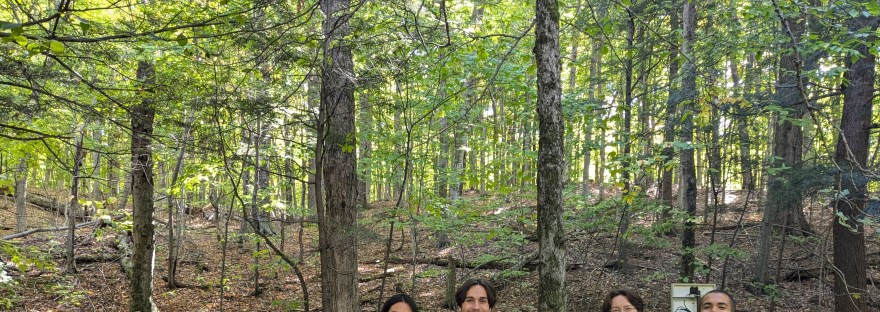
This past weekend, ECOHYDROS was invited to present their research at Gault Nature Reserve's Biodiversity Festival.

Ecohydrological Systems Laboratory – Laboratoire sur les systèmes écohydrologiques
Led by Genevieve Ali – Dirigé par Geneviève Ali | McGill University
This past weekend, ECOHYDROS was invited to present their research at Gault Nature Reserve's Biodiversity Festival.
by | par: Alina KostyukTranslation by | traduit par: Florence Dancose Une version française de cet article suit la version anglaise. With the onset of climate change and global warming, extreme weather events, especially those relating to rain patterns, are a major concern. This is because warm air can hold more moisture than cold air,… Continue reading Extreme Rain: Tropical Storm Debby | Précipitation extrême: la tempête tropicale Debby
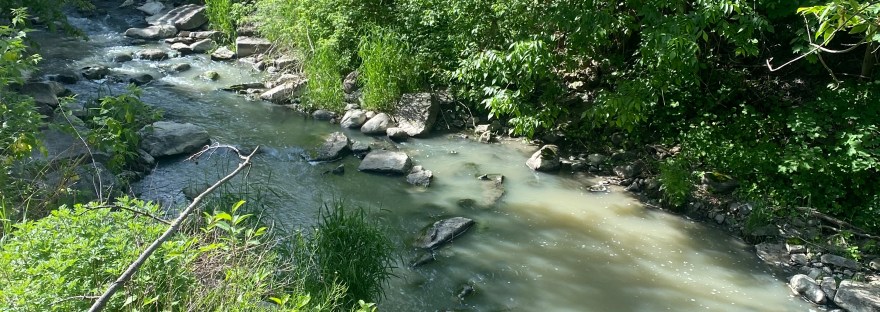
This summer, I am studying the impact of extreme weather events on the water quality of Ours Creek, an important tributary of the Hurons River. Located in Montérégie, the river is labelled as having a very bad water quality in the province of Québec. I am analyzing 44 different water quality parameters, including total dissolved phosphorus, trace metals, and isotopic signatures, to better understand contaminant transport mechanisms. One of the parameters I’m focusing on is the concentration of fecal coliforms in the water, which serves as an indicator of contamination from fecal matter such as manure and sewage.
In anticipation of a very busy summer 2024 with lots of field installations to complete and science communication initiatives to push forward, we made a call for 2 to 4 undergraduate research assistants. As of this month, we are extremely pleased to have Olivier Grégoire, Seonaid Newell-Macintosh, Corinne Arson and Gabriel Morales-Guillén join our team.… Continue reading New group members: May 2024 | Nouvelles additions au groupe : Mai 2024
Jack Moore successfully defended his M.Sc. thesis at the University of Guelph today. Congratulations! More details on Jack's research project can be found here: https://agsoilwater.wordpress.com/
Rivers have played a central role in the historical, cultural, and economic development of Quebec. The current and future ability of rivers to support both human life and wildlife depends on the quantity (flow) and the quality (chemistry) of the water that moves in river channels. While all Quebecers know about major water extremes, from… Continue reading New science communication project: Because each river has its own rhythm…
Les rivières ont joué un rôle central dans le développement historique, culturel et économique du Québec. La capacité actuelle et future des rivières à préserver la vie humaine et la biodiversité dépend de la quantité (débit) et de la qualité (chimie) de l’eau qui y circule. Les Québécois connaissent bien les extrêmes hydrologiques majeurs qui… Continue reading Nouveau projet de communication scientifique : Parce que les rivières ont chacune leur rythme…
Nous sommes ravis – et reconnaissants – que notre demande de financement auprès de la Fondation canadienne pour l’innovation et du ministère de l’Économie et de l’Innovation du Québec ait été approuvée. Ce nouveau financement nous permettra de déployer une gamme d'instruments sur le terrain pour étudier la connectivité écohydrologique. Plus de détails à venir… Continue reading Nouvelle subvention de recherche en lien avec la connectivité écohydrologique
We are excited - and thankful - that our funding application to the Canadian Foundation for Innovation and the Ministère de l’Économie et de l’Innovation du Québec was successful. This new funding will allow us to deploy a range of instruments in the field to monitor ecohydrological connectivity. More details to come in 2024 when… Continue reading New funding for ecohydrological connectivity research
We are pleased to welcome three new members to the group this fall. Leila Khalid is an undergraduate student in Environment at McGill, starting an Honours thesis research project focused on fecal coliforms and their variation across five dozens of Quebec river locations in southern and northern Quebec. Liya Miliya is starting a M.Sc. in… Continue reading New group members: September 2023 | Nouvelles additions au groupe : Septembre 2023
 Ecohydrological Systems Laboratory - Laboratoire sur les systèmes écohydrologiques