
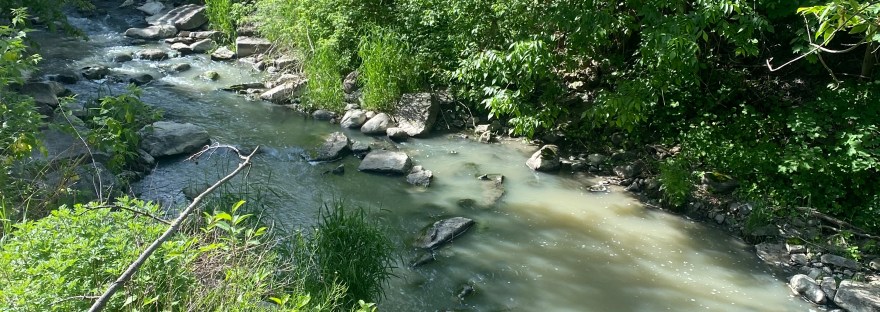
On May 13th, 2025, a team of ECOHYDROS students visited five rivers between Montréal and Trois-Rivières. The team collected water samples from the Assomption, Yamachiche, Nicolet, Saint-François, and Richelieu rivers in preparation for hosting interactive science-outreach activities.
Category: Field work
Extreme Rain: Tropical Storm Debby | Précipitation extrême: la tempête tropicale Debby
by | par: Alina KostyukTranslation by | traduit par: Florence Dancose Une version française de cet article suit la version anglaise. With the onset of climate change and global warming, extreme weather events, especially those relating to rain patterns, are a major concern. This is because warm air can hold more moisture than cold air,… Continue reading Extreme Rain: Tropical Storm Debby | Précipitation extrême: la tempête tropicale Debby
Tracking Fecal Coliforms: How Human Activities Affect Water Quality | Étudier les coliformes fécaux: l’effet des activités humaines sur la qualité de l’eau
This summer, I am studying the impact of extreme weather events on the water quality of Ours Creek, an important tributary of the Hurons River. Located in Montérégie, the river is labelled as having a very bad water quality in the province of Québec. I am analyzing 44 different water quality parameters, including total dissolved phosphorus, trace metals, and isotopic signatures, to better understand contaminant transport mechanisms. One of the parameters I’m focusing on is the concentration of fecal coliforms in the water, which serves as an indicator of contamination from fecal matter such as manure and sewage.
275 Samples and 276 Mosquito Bites
--by Thanuja Thavarasa Living organisms need a variety of nutrients in order to grow. For plants, nitrogen is an essential nutrient. Nitrogen, found in the form of nitrate (NO₃ˉ), is taken up through plant roots from the surrounding soil. Thus, we thought it would be interesting to explore the relationships between soil nitrate concentrations and… Continue reading 275 Samples and 276 Mosquito Bites
If you were wondering why the Dairy Bush was blue… It was us.
-- by Thanuja Thavarasa, on behalf of myself, Aidan Doak and Jamie Bain Water flow through soil is quite complex. It can move either vertically or horizontally dependent on a variety of factors like soil texture and different types of rainfall events. It can be valuable to know these water flow patterns since they can… Continue reading If you were wondering why the Dairy Bush was blue… It was us.
Testing the “two-water-worlds” hypothesis in southern Manitoba ~ by Janelle Laing
During the 2015 field season, members of our research group conducted a study on the Fort Garry campus of the University of Manitoba; the study aimed to test the “two water-worlds” hypothesis, which suggests that plants preferentially access tightly-bound soil water over mobile soil water. We collected rainwater, streamwater, mobile soil water (using suction lysimeters), bulk… Continue reading Testing the “two-water-worlds” hypothesis in southern Manitoba ~ by Janelle Laing
What is the relative importance of soil water versus bedrock groundwater?
While most of Prairies are relatively flat, the Pembina escarpment (also called Manitoba escarpment) is a striking topographic feature responsible for the presence of few steep-sloped landscapes in Manitoba. Because the escarpment is associated with the presence of different shale units and bedrock fractures, however, its impact on regional hydrology is probably much more complex… Continue reading What is the relative importance of soil water versus bedrock groundwater?
2015 MCDA Tour hosted by the Lasalle Redboine CD
As part of Laura Blunden's summer experience with the Watershed Systems Research Program (WSRP), she played an instrumental role in partnering with various stakeholders and was fortunate to attend the Manitoba Conservation District Association’s (MCDA) tour. The tour was held on June 16, 2015 by the LaSalle Redboine Conservation District for the Pelly’s Lake watershed… Continue reading 2015 MCDA Tour hosted by the Lasalle Redboine CD
Quick recap of the 2015 MSSS Tour
On June 18, 2015, Laura Blunden attended the Manitoba Soil Science Society (MSSS) tour with the University of Manitoba Watershed Systems Research Program (WSRP). The tour stopped at the Classen Farm, which is currently being studied by Ph.D. student Kokulan Vivekananthan and other researchers from the University of Manitoba and the University of Waterloo to… Continue reading Quick recap of the 2015 MSSS Tour
New dye tracing experiment this summer
A dye tracing experiment was conducted at the Classen site in the La Salle River watershed on June 8th, 2015. Blue dye was applied to two plots and soil profiles were excavated three days later to reveal the flow pathways present in the thick clay soils of the area. After getting covered in blue dye… Continue reading New dye tracing experiment this summer

